Who Gets Asked
Voters in dozens of towns sided against data centers on November 3, and many of those votes cannot stop projects already underway. They did reopen an old fight over who sets the terms for a power grid everyone depends on.
“Data centers in space looking pretty appealing right now,” Elon Musk posted on X the day after Texas voted. He had spent at least $474 million on the midterms, a record by CNBC’s count, $224 million of it in Texas. Ken Paxton, the Republican Senate candidate he backed, lost to Democrat James Talarico, 55.1 percent to 43.0. Gov. Greg Abbott, a Republican he also supported, lost to Democrat Gina Hinojosa, 52.8 to 45.7. Hinojosa had promised a statewide moratorium on new data center approvals. It was a strong Democratic year, and nothing we found shows data centers decided either race.
The joke points at something true. Musk’s largest AI sites are outside Texas. Reuters places Colossus and Colossus II, two giant data centers, near Memphis. A Texas governor cannot reach them.
The towns show the same gap between anger and reach. Voters went against data centers by huge margins, often in votes that cannot touch what is already being built. What they reopened is a plainer question: who gets asked before one of these sites plugs into the grid everyone shares? Democrats take Congress in January, but they will fall short of the votes to override a veto, and most Senate bills need 60 votes, so new federal law along party lines is unlikely. The fight moves to subpoenas, governors, utility commissions and local ballots.
A pause a Republican started
Hinojosa did not start the Texas pause. Abbott did. On August 3 he ordered an audit of data centers seeking grid connections and put those projects on hold until it is done. On September 21 he told the state environmental agency to “pause the issuance of all permits related to data center projects.” In a report published two days before the vote, he was quoted saying “everything is on hold,” and calling for rules making local governments “the decision makers.” Meanwhile Musk supplied nearly one-fifth of his latest $26 million haul, according to the Texas Tribune.
Hinojosa’s pledge goes further. Reuters reports a ban on all approvals until lawmakers pass laws “so that Texans have a seat at the table to decide if and how data centers come into our community.” Reuters does not say how permitted projects would be treated, and her wording has shifted since July.
Reuters also says the audit is expected to end this year and describes some of Abbott’s measures as near-term. Hinojosa takes office in January. DLA Piper, a law firm, notes the directive does not say what findings would lift the freeze. Ending tax breaks takes state lawmakers, and results so far point to a split Texas Legislature: a Democratic House, 83-67, and a Republican Senate, 19-12.
Musk’s Texas stake is real and hard to measure. Reuters calls the state home to Tesla, SpaceX and a planned chip venture, and says new facilities are planned at Starbase. In July, Reuters, citing The Information, reported SpaceX was preparing at least one large new Texas data center, at Memphis scale or larger. We found no site, permit or company confirmation. A trade report says a Tesla training cluster came online at its Texas factory this year.
Colossus is being fought over elsewhere. A federal judge in Mississippi refused on October 30 to dismiss an NAACP suit alleging that xAI, Musk’s AI company, now owned by SpaceX, and another firm ran 27 gas turbines, by CNBC’s count, without an air permit. xAI argued the turbines were exempt mobile sources; the judge disagreed at this stage. The ruling lets the case proceed and does not find xAI at fault. Silicon Valley House Democrats wrote in October that the next Congress “will closely scrutinize federal funding awarded to Mr. Musk’s businesses,” and Punchbowl forecasts he will be an early target. We found no announced subpoena. A subpoena can compel an answer. It cannot deny a permit.
What the towns did
Start with Ashville, Ohio, where about 82 percent voted no, repealing the village’s agreement with the developer EdgeConneX. A local station had explained beforehand: “The referendum would not halt construction of the data centers, which is already underway.” The repealed resolution outlined a deal still to be negotiated. It also exempted the project from a village moratorium; nothing we found says what repeal does to that. Also open is an 800-megawatt gas plant needing the state Power Siting Board’s approval. Once certified, no local government may require its own approval of the plant’s location, design or pollution controls.
Ballotpedia counted 41 local measures in 10 states. By midday on November 4, a tracker from the lobbying firm Duane Morris Government Strategies had 38 called, with voters limiting development in 37. The exception was Harwood, North Dakota, where 75 percent of 430 voters rejected extra review for large industrial projects.
Some votes bind no one. GridSight, which says it briefs county boards and project teams, labels nine of the 41 advisory, including a Joliet Township question that failed about 79-21. Others look ahead, like the charter ban in Edgewater, Florida, where no project was proposed. And some are live. A ban in Sunbury, Ohio, targets a planned Amazon campus whose fate Fortune calls unclear; Amazon would not say whether the measures change its plans.
In Trenton, Ohio, about 80 percent approved a charter amendment barring data centers above 25 megawatts. Prologis is developing a 250-megawatt campus there for Amazon Web Services. Before the vote, the measure’s lawyer said it would cap that project at a tenth of its size, and the city said existing permits let it continue. No court has ruled.
Emporia, Kansas, passed a 10-year ban on data centers of 10 megawatts or more, or using over 10,000 gallons of water a day, but it may not hold. A judge has yet to rule on whether the petition made new policy or merely administered existing policy. If the latter, the local station KVOE reports, the prevailing theory is that the ban is most likely void.
Wilmington, Ohio, shows a vote undoing a specific plan: about 80 percent rejected the rezoning of four parcels. Amazon’s separate campus, about 471 acres, was rezoned by emergency ordinance, which normally escapes referendum. A resident has sued, calling the emergency “illusory,” and the Ohio Supreme Court said in the Ashville case that an emergency clause needs specific reasons. The same town shows the tool and a contested way around it.
As of November 4, we had seen no report of a project canceled because of a November 3 vote.
Georgia’s three votes
In Georgia the fight ran through a different office. The Public Service Commission is five elected regulators who oversee how Georgia Power supplies electricity. They do not regulate data center construction. In December 2025, an all-Republican commission unanimously certified about 9,885 megawatts of new supply, roughly 60 percent gas, at a cost of at least $16 billion. Certification lets the utility later bill customers for a plant. Georgia Power says data center contracts are “structured where they are paying more.” Staff said, “There’s no guarantee that bills will go down.”
In February, the commission refused 3-2, on party lines, to reconsider. One of those three Republicans, Tricia Pridemore, did not run again. On November 3, unofficially, Democrat Shelia Edwards won the open seat and Democrat Peter Hubbard kept his, which will give Democrats a 3-2 majority once she is seated, the first in more than 20 years, according to the Atlanta Journal-Constitution. Bills had risen six times in three years, and nothing we found shows the plan decided these races. Edwards’s Republican opponent also opposed the December expansion and wanted it phased in.
The Journal-Constitution says new regulators are likely to revisit the plan but does not say how. Rates and profits are not scheduled for review until 2028, and the freeze on base rates, which excludes fuel and storm costs, runs through at least that year. Whether three votes can reopen a certificate already granted is a question we could not answer from public reporting.
The subject is who pays, and the evidence is mixed. A preprint led by researchers at the Electric Power Research Institute, which works closely with utilities, estimates data centers modestly lowered average rates through 2024, and cautions that “future supply constraints could reverse the effect.” The market monitor for PJM, the grid operator serving Ohio, Virginia and other states, attributes $29.4 billion in payments that keep power plants available, across four auctions, to existing and forecast data center load. The national rate studies we read end in 2024, before the current build.
The elevators
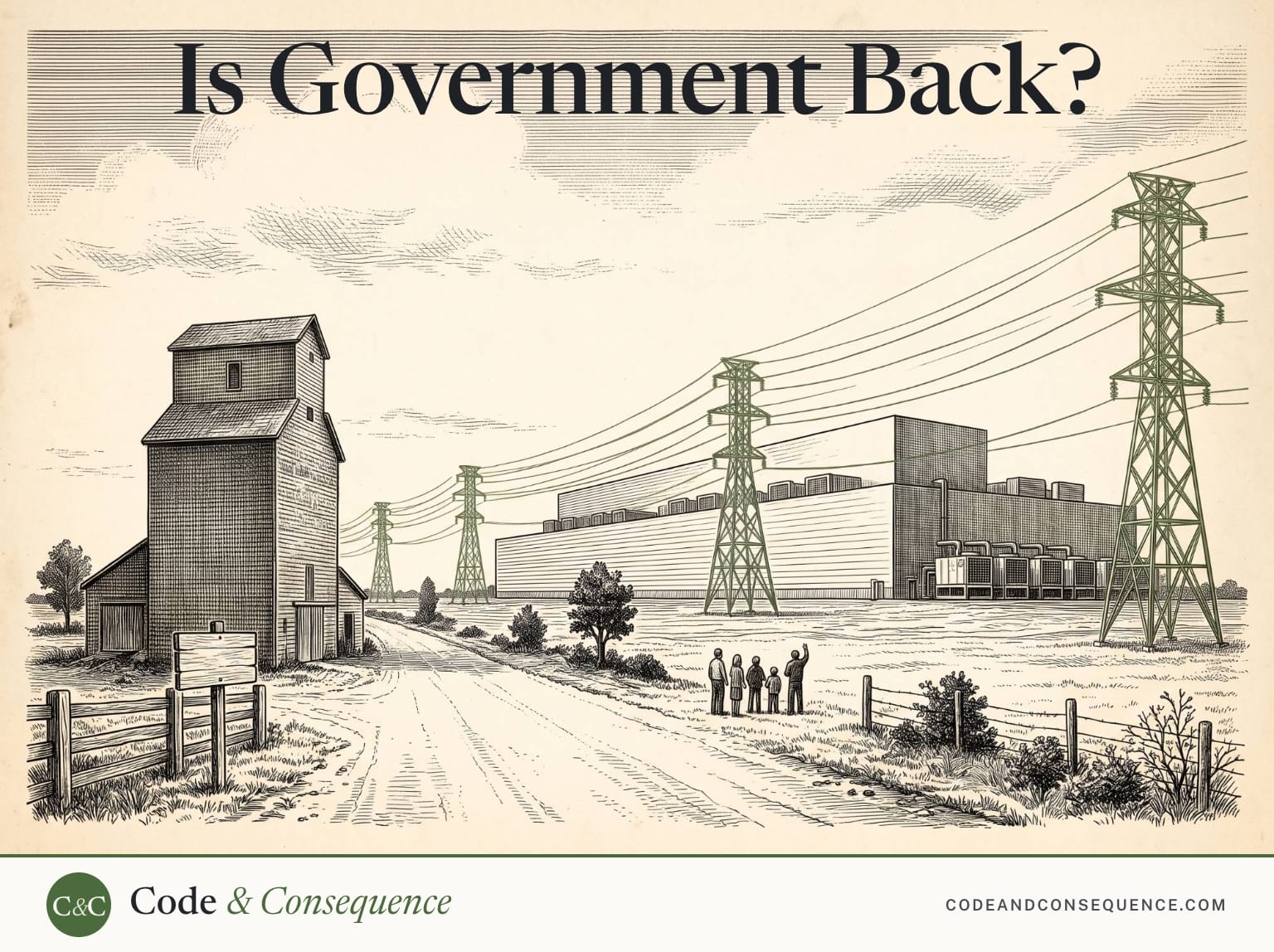
The country has had this argument before. In the 1870s, four states, Illinois, Iowa, Wisconsin and Minnesota, limited railroad rates, and Illinois regulated grain elevators, the warehouses that held a farmer’s crop on its way to market. The pressure came from the Grange, a farm order, and in Illinois from Chicago merchants.
The famous test case concerned elevators; railroads came in companion cases. Munn v. Illinois, decided 7-2 in 1877, records that in 1874 nine firms controlled Chicago’s fourteen warehouses. Chief Justice Waite, borrowing a phrase from the owners’ lawyers, wrote that the elevators stood in the “gateway of commerce” and took “toll from all who pass.” The Court upheld the state’s storage cap, reasoning that property becomes “clothed with a public interest” when its use affects the community at large. Justice Field warned in dissent that “all property and all business in the State are held at the mercy of a majority of its legislature.”
Answering the fear of abusive rates, Waite wrote a sentence that reads differently this month: “For protection against abuses by legislatures the people must resort to the polls, not to the courts.”
Nine years later came Wabash, a railroad case. The Court held that rules for interstate traffic “cannot be safely and wisely remitted to local rules and local regulations,” leaving in-state rates to the states. About three months later Congress passed the Interstate Commerce Act. The National Archives’ verdict: “In practice, the law was not very effective.” Most of these Granger laws were soon repealed or drastically modified.
The analogy has limits. The Grangers capped the price of a service already running. A town ban decides whether a building may go up at all, and its closer legal ancestor is zoning, upheld in Euclid v. Ambler Realty, also from Ohio. And the elevators were a toll gate. A data center’s neighbors do not pass through it; what they share with it is the grid. None of this history predicts an outcome.
What may carry over is the way these fights climb, though so far the climb is faint. West Virginia overrode local rules on certified data centers, according to the policy firm MultiState. A bipartisan Senate bill to speed energy permits faces a procedural vote scheduled for November 9. It would bar utilities from passing the added cost of serving facilities of 20 megawatts or more on to other customers. “The answer cannot be to simply stop building,” Josh Freed of Third Way said in ENR. But as one law firm reads the text: “Whether a data center gets built remains, first, a question of community support and, second, a state and local question of zoning, siting, and permits.”
So the bill, if it passes, would start to answer who pays and leave who gets asked to towns and states. Waite sent people who feared regulation to the polls. In Ohio and Kansas the voters did the regulating, and the courts may still get the last word. The farmers lost most of their statutes. What seems to have lasted is the question they forced: when a whole community has to pass through the same gate, who does the gatekeeper answer to? On the grid in 2026, that depends on which office holds the form that still needs a signature.
Research checked November 4, 2026. Results are unofficial and may change at certification. OpenSecrets, via Newsweek, puts Musk’s midterm total at $445.5 million, using filings through October 14.